When organisations come under pressure, the instinctive response is often to ask people to work harder, move faster, or simply push through.
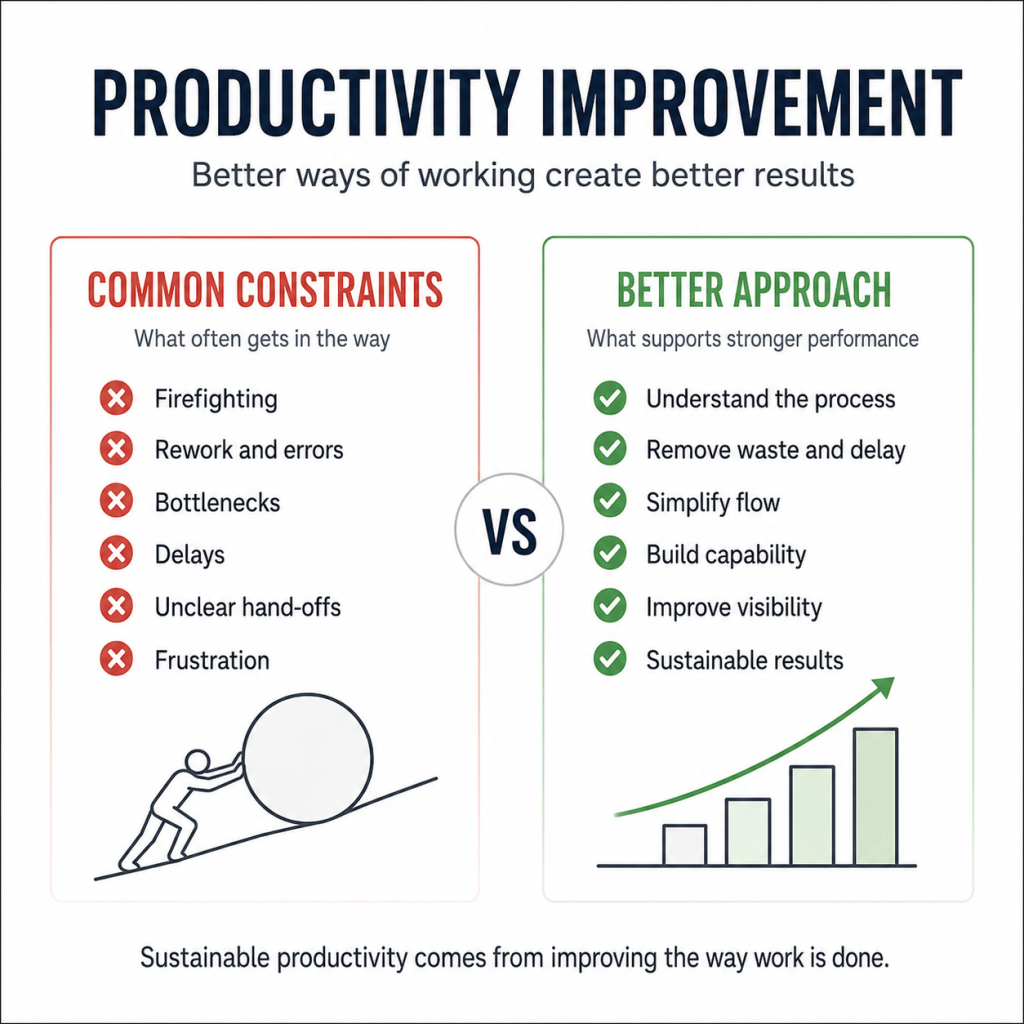
That may create a short-term increase in activity, but it rarely creates sustainable productivity improvement.
In many cases, the people are already working hard.
The real issue is often the way the work itself has been organised.
As organisations grow, processes tend to become more complicated. More hand-offs appear. More approvals are added. More checking is introduced. Information starts moving between different systems. Workarounds become normal.
Before long, managers spend much of their time firefighting and teams become busy dealing with problems created by the process itself.
There is plenty of activity, but not necessarily more value.
Improvement is not about asking people to work harder. It is about making it easier for people to do good work.
Busy does not always mean productive
One of the easiest traps to fall into is confusing effort with output.
A team can be extremely busy while still losing significant time through waiting for information or decisions, duplicated work, unnecessary approvals, rework, poorly defined responsibilities, bottlenecks between functions, searching for information, or dealing with recurring problems.
None of these issues are solved simply by asking people to work harder.
In fact, adding pressure can sometimes make things worse. People take shortcuts, mistakes increase and managers become even more involved in day-to-day problem solving.
The result can be a workforce that is working harder without the organisation actually becoming more productive.
Start by understanding how the work really happens
Sustainable improvement starts with understanding the current process.
Not how the process is supposed to work.
How it actually works.
That means following the work from beginning to end, talking to the people involved and looking at where time is being lost.
Where does work wait?
Where does information get handed from one person to another?
Where are decisions delayed?
Where is work being repeated?
Where are managers continually stepping in to solve the same problems?
Often, the biggest opportunities are surprisingly simple once the process is made visible.
Involve the people doing the work
The people closest to the process usually understand its frustrations better than anyone else.
They know which systems are awkward.
They know where information is missing.
They know which approvals add little value.
They know where customers are being kept waiting.
They also tend to have practical ideas about how things could work better.
This is why improvement should not be something that is done to people.
It works best when people are involved in understanding the problem, testing better ways of working and seeing whether those changes actually improve performance.
That involvement also builds capability.
Instead of managers repeatedly solving problems for the team, people gradually become better at identifying issues, understanding causes and making improvements themselves.
Focus on the few things that matter
Another common problem is trying to improve too much at once.
An organisation might identify dozens of possible improvement opportunities and attempt to tackle all of them.
The result is usually a long action list and very little sustained progress.
A better approach is to identify the few issues that are having the greatest impact on performance and focus on those first.
For example:
- one bottleneck affecting customer lead time;
- one recurring quality problem;
- one planning issue causing excessive firefighting;
- one management routine that is not providing useful visibility;
- one process where responsibilities are unclear.
Solve something meaningful, measure the result, learn from it and then move on to the next opportunity.
Small, well-executed improvements usually create more momentum than a large programme that never quite gets embedded.
Productivity improvement is also about capability
Improvement is not just about fixing the process.
It is also about developing the people who run it.
If every operational problem still requires a senior manager to step in, then the organisation remains dependent on that manager.
If teams are given the tools, confidence and responsibility to understand and improve their own work, the organisation becomes more capable.
That is where sustainable productivity improvement really begins.
The process gets better.
The people become stronger.
Managers spend less time firefighting.
And the organisation gains capacity without simply asking everyone to work harder.
A useful question to ask
If your organisation feels busy but performance is not improving at the same rate, ask:
Where are we losing time, capacity or management attention because of the way the work is organised?
The answer is often a much better starting point than asking people to work harder.
Richard Steel
Achieving results by developing people.



Leave a comment