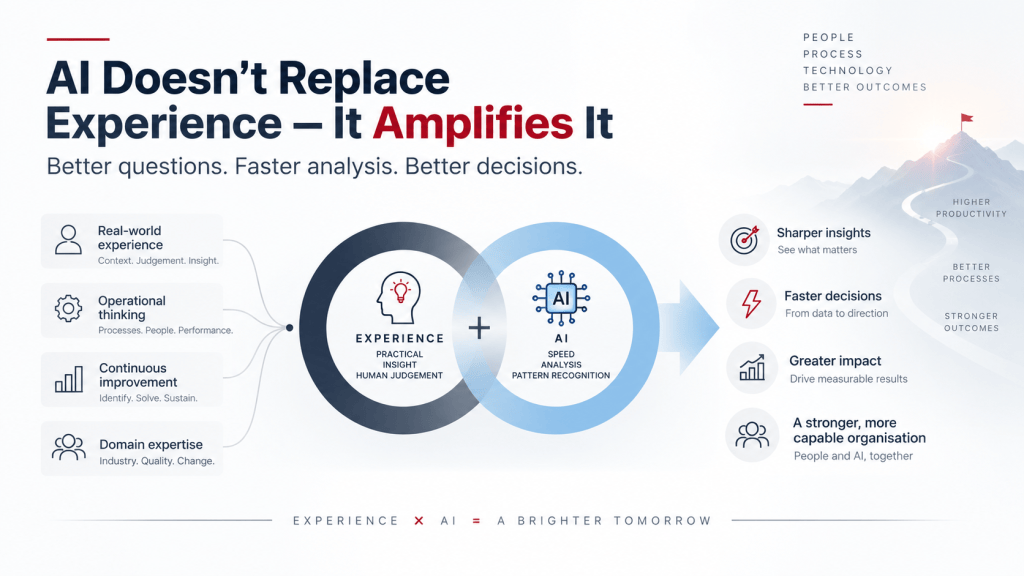
AI Doesn’t Replace Experience — It Amplifies It
There is no shortage of discussion about what AI might replace.
Jobs. Tasks. Expertise. Consultants. Managers.
I think that misses one of the more interesting opportunities.
Used well, AI can make an experienced person considerably more effective. But it still needs someone to understand the problem, recognise what matters and ask the right questions.
That distinction becomes particularly important when we start applying AI to real business processes.
A business may know it has a problem because orders are late, customers are complaining, margins are under pressure or everyone seems permanently busy.
AI can help analyse information around those issues.
But first someone still needs to ask:
What is actually going wrong?
Symptoms are not always causes
One of the things experience teaches you is not to jump too quickly from a symptom to a solution.
A business might say:
“We need more people.”
Perhaps.
But the real issue might be poor scheduling, incomplete information, excessive approvals, rework, an overloaded bottleneck or a process that depends on one individual.
Or someone might say:
“We need a new system.”
Again, perhaps.
But putting new technology on top of a poorly understood process can simply automate the confusion.
This is where I believe experience and AI complement each other particularly well.
Experience helps you recognise patterns, challenge assumptions and understand where to look.
AI can then help accelerate the analysis.
Where AI can add real value
The smaller applications are already familiar: drafting documents, summarising meetings, analysing feedback and helping create procedures.
Useful, certainly.
But I think the bigger productivity opportunity lies in using digital tools and AI across broader business processes.
Consider something as common as quoting.
An enquiry arrives by email. Someone reads it and transfers the information somewhere else. Another person checks technical details. Pricing is prepared. Approval may be needed. A quote is created and sent. Once accepted, much of the same information is entered again into an order or production system.
There may be several handoffs, repeated data entry and plenty of opportunities for things to wait or go wrong.
The opportunity isn’t simply:
“Can AI write the quote?”
The more useful questions are:
Which steps genuinely add value?
Where does information get duplicated?
Which decisions require human judgement?
Which activities could happen automatically?
What could be removed altogether?
That is process improvement first and technology second.
Experience helps provide context
AI can process a great deal of information very quickly.
What it does not automatically know is what matters most to a particular business.
An experienced operations person walking through a workplace may notice something seemingly small:
A queue consistently building in front of one process.
Operators compensating for a recurring quality problem.
A manager being interrupted repeatedly for routine decisions.
Two departments keeping separate versions of the same information.
A procedure that bears little resemblance to what actually happens.
Individually, none may look dramatic.
But experience helps connect them.
You begin asking:
Why does that happen?
How often?
What does it cost?
What happens upstream?
What happens downstream?
What has everyone simply learned to tolerate?
AI can help considerably once we know what we’re trying to understand.
The “new normal”
Businesses are remarkably good at adapting.
Unfortunately, that sometimes means adapting to things that shouldn’t be accepted in the first place.
People create spreadsheets.
They develop workarounds.
They add another check.
They email someone “just to make sure”.
They keep their own notes because they don’t trust the system.
Eventually the workaround becomes the process.
It becomes the new normal.
One of the most useful roles an outside perspective can play is simply making that friction visible again.
AI can then help us analyse it, document it, compare alternatives or accelerate the implementation of a better way.
But we first need to see it.
Productivity, quality and AI belong in the same conversation
This is also why I increasingly see productivity, quality and technology as interconnected.
Poor quality creates rework.
Rework consumes capacity.
Lost capacity creates delays.
Delays create cost and customer frustration.
Technology may help — but only if we understand the chain.
The objective isn’t to “use AI”.
The objective might be to:
- reduce lead time
- improve first-time-right performance
- increase available capacity
- remove repetitive administration
- improve decision-making
- make information flow more reliably
AI is simply one possible enabler.
Continuous improvement still matters
For me, continuous improvement has always been a mindset rather than a collection of tools.
Never assume the current way is necessarily the best way.
Customers change.
Regulations change.
Technology changes.
Markets change.
People change.
So the organisation needs to keep learning and adapting.
AI gives us another powerful set of tools with which to do that.
But the fundamentals haven’t disappeared.
Understand the work.
Involve the people who do it.
Identify the real problem.
Simplify where possible.
Test changes.
Measure the outcome.
Then use technology where it genuinely helps.
The opportunity
I don’t believe experience and AI sit on opposite sides of a debate.
For experienced people, AI can be an extraordinary force multiplier.
It can help us analyse more information, consider options faster, document work more efficiently and turn ideas into something usable much more quickly.
But experience still provides context, judgement and the ability to recognise the question that actually needs answering.
Perhaps the better question isn’t:
“What can AI replace?”
It is:
“What could experienced people achieve if AI removed some of the friction from the way they work?”
That is the conversation I find much more interesting.

 Diary of a Kaizen Warrior
Leave a comment