Turning “words on the wall” into daily action
I recently had the pleasure of joining Brad Jeavons on the Enterprise Excellence Podcast to talk about a topic that’s close to my heart — how organisations can truly connect their people, culture, and strategy to achieve sustainable improvement
It’s a conversation that comes up often in my work:
Why do so many organisations struggle to turn their strategic intent into meaningful daily action?
The “Words on the Wall” Problem
Many organisations spend time developing vision and values statements — they launch them with enthusiasm, hang them in reception, and mention them at the annual conference.
But a few months later, those same values fade (sometimes literally) into the background.
I once visited a company and asked a team member about their strategy and values. After a moment’s hesitation, they pointed to a faded poster on the wall. “I remember we had a launch workshop for that,” they said. “It was really good.”
That’s what I call the “words on the wall” problem.
Culture and strategy aren’t what we say; they’re what we do — especially when no one’s watching.
From Strategy to the Frontline
Over the years, I learned that improvement must be both top-down and bottom-up. Strategy gives direction, but the real transformation happens when frontline teams understand how their work contributes to the bigger picture.
One of my mentors from Shingijutsu, Yoshiki Iwata, once told me (through an interpreter):
“Start improvement as close to the customer as possible, so they will get the benefit as quickly as possible.”
That thinking has guided me ever since.
When the frontline understands the why behind the organisation’s goals — and sees how their actions directly impact customer outcomes — that’s when strategy comes to life.
Making It Real: Connecting Behaviour and Values
One of the most powerful ways to embed culture is by translating values into observable behaviours.
Don’t just tell people what the values are — help them see what those values look like in practice.
For example, I worked with a large retailer where one department struggled to see how they could influence customer satisfaction. Together, they came up with a simple idea: staff from the meat department started helping customers choose produce for dinner. It not only improved customer satisfaction scores but boosted morale too.
Small actions like that, when connected to purpose, reinforce culture far more effectively than any slogan.
Leadership’s Role in Alignment
Leaders play the critical role of translating strategy into clarity.
That means:
- Keeping goals simple and relatable.
- Involving teams in shaping improvement ideas and solving problems — this is essential for embedding continuous improvement. When people are part of identifying issues and creating solutions, they take ownership, and improvement becomes part of the culture rather than a one-off project.
- Communicating — and then communicating again.
- Recognising and celebrating the right behaviours.
A few kind words at a daily huddle, a handwritten thank-you card, or a box of chocolates can sometimes achieve more than formal incentive schemes. Recognition fuels engagement — and engaged teams deliver results.
Practical Ways to Align Leadership and Strategy
If you want to start aligning your leadership team around operational objectives, here are a few simple steps:
- Make the strategy visible — use visual management boards to track key goals and progress.
- Build daily and weekly huddles around those goals — create space for conversations that link results to behaviours.
- Reward alignment, not just outcomes — recognise when teams live the values, not just hit the numbers.
- Simplify communication — avoid jargon; make sure everyone can explain what success looks like in their own words.
When done well, these practices transform culture, connect people to purpose, and make improvement self-sustaining.
Final Thoughts
Every organisation wants engaged teams, consistent leadership, and sustainable improvement.
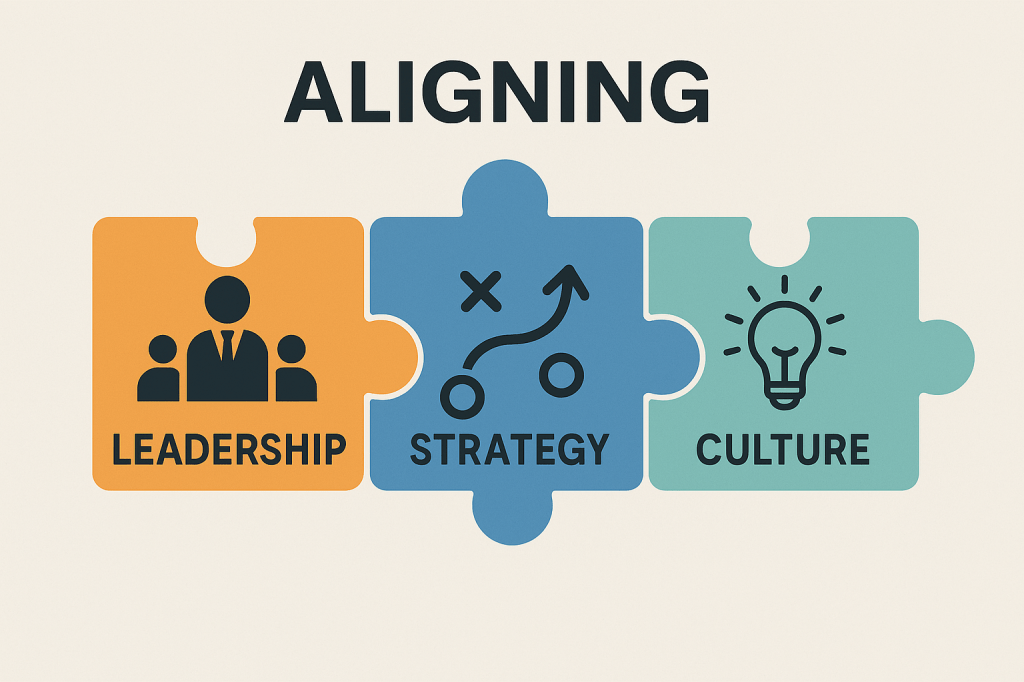
The missing link is often alignment — making sure everyone, from the boardroom to the shop floor, is working toward the same goals and guided by the same values.
As I said in the podcast:
“You don’t find culture written on posters — it’s how people behave when no one’s watching.”
If your organisation is looking to better align leadership and strategy, or to turn improvement activity into measurable outcomes, I’d love to have a conversation about how we can help.
Listen to the full episode: https://www.buzzsprout.com/1120772/episodes/17961109-207-aligning-improvement-activities-to-company-vision-values-goals-with-richard-steel
Learn more: www.richardsteel.co.nz | LinkedIn: Richard Steel

 Diary of a Kaizen Warrior
Leave a comment